“How many cold emails can I send per day?” is actually two questions wearing one trench coat:
- What’s the maximum my provider allows? (a settings question)
- How many should I send before replies fall off a cliff? (a revenue question)
Everyone asks #1. Money lives in #2. This article answers both, with 2026 data.
The technical answer: what providers allow
| Provider | Daily cap | Notes |
|---|---|---|
| Google Workspace (paid) | 2,000 recipients/day | Rolling 24-hour window, not midnight reset |
| Google Workspace (trial) | 500/day | Rises after $100 cumulative billing + 60 days |
| Free Gmail | ~500/day | Shared reputation; riskier for outreach |
| Workspace mail merge | 1,500/day | Lower than the standard cap |
Sources: Woodpecker’s 2026 sending-limits breakdown . Corroborated by Mailreach’s 2026 Workspace guide
Exceed the cap and Gmail blocks sending for up to 24 hours; repeat it and the suspensions get longer while your domain reputation takes damage that outlasts the lockout.
Now forget those numbers. Here is why they are a trap.
The real answer: 20–50 per inbox per day
Across every serious 2026 deliverability guide, the safe band for cold outreach converges on the same place:
- 20–30/day for a new or warming inbox (week 1)
- 40–60/day by week 2, 70–100/day by week 3 of ramp-up
- ~50/day per mailbox as the steady-state rule of thumb
- Aerosend’s 2026 guidance puts the cold-email safe zone at ~25/day; aged, warmed Gmail accounts stretch to 30–50/day
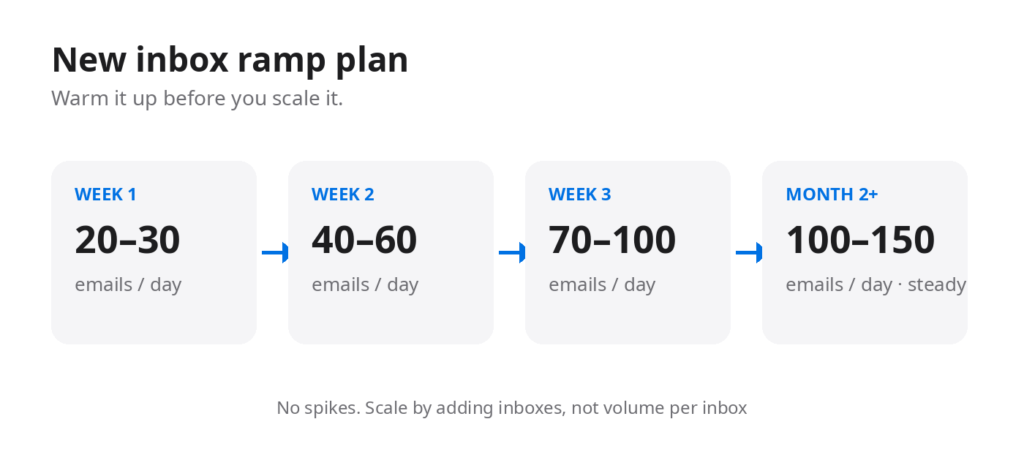
Sources: Woodpecker 2026 sending guide (ramp schedule); Woodpecker’s 2026 cold email checklist (“~50 emails per day per mailbox”); Aerosend’s 2026 Gmail limits FAQ .
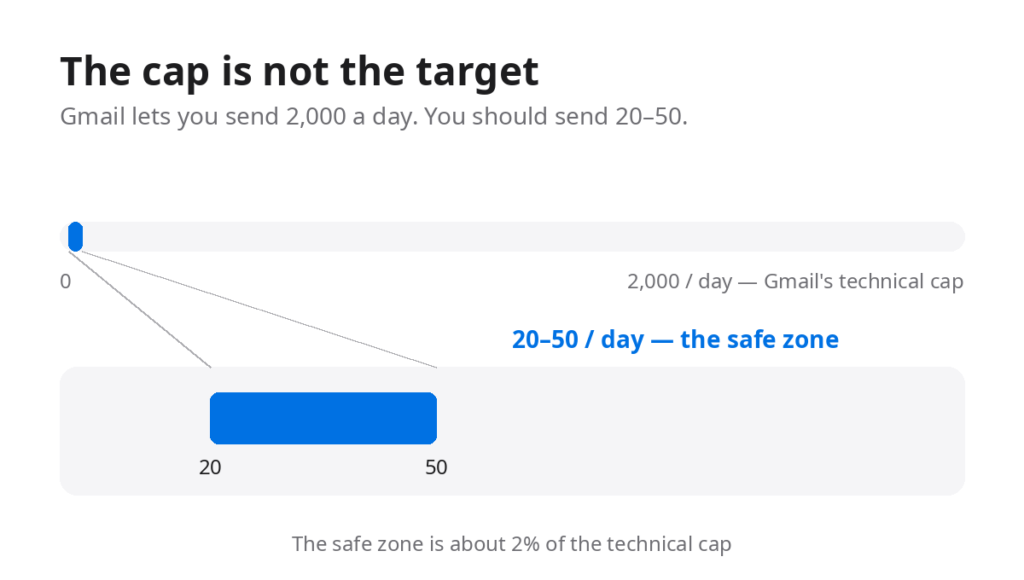
Notice the gap: the technical cap is 40–80x the safe practice. The cap is a fire exit, not a target.
The stat that settles it: volume kills replies before it kills deliverability
Woodpecker’s 2026 campaign benchmarks (published via their official channel) split mailboxes by daily volume:
- Mailboxes averaging 1–20 emails/day: 2.0% median reply rate, 41% median open rate
- Mailboxes averaging 101–200 emails/day: 0.5% median reply rate, 23% median open rate
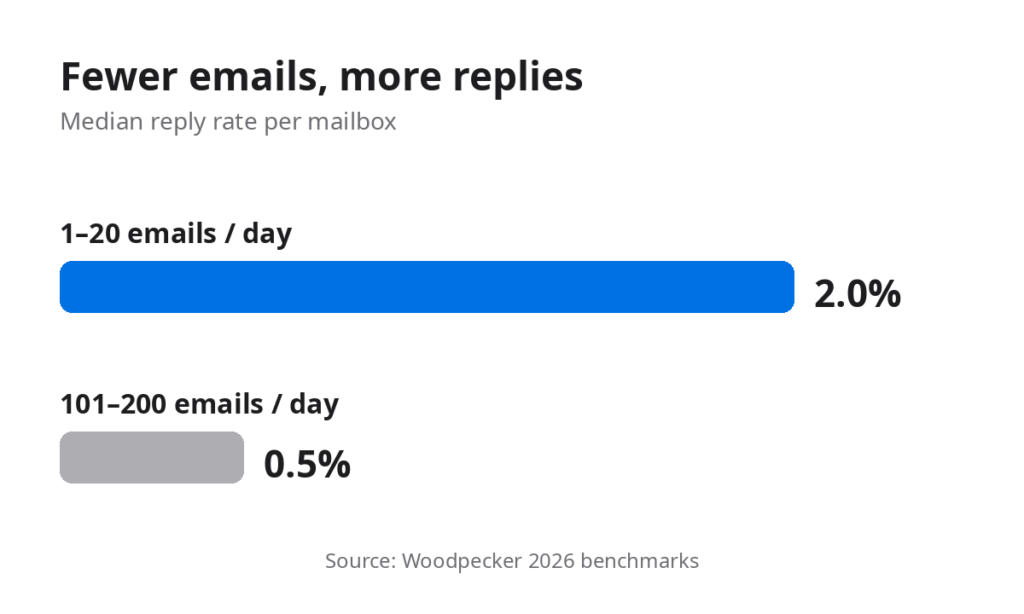
Same platform, same year. The low-volume inbox gets four times the replies. Source: Woodpecker.co official LinkedIn benchmarks post, October 2026
Read that again, because it inverts the usual logic. People obsess over deliverability — “will I land in spam at 150/day?” — but the data says the bigger tax arrives earlier: recipients can smell bulk. Reply rate dies before deliverability does. The limit isn’t a setting in your sending tool. It’s recipient behavior.
For context on what “good” looks like overall: across 20M+ emails, Woodpecker’s data puts average cold reply rates at 1–5% , and sequences with 4–7 follow-ups average 27% reply rates versus 9% for short ones. Volume is not the lever. Follow-up is.
Why high volume fails (the mechanism)
- List quality dilutes. Your first 50 prospects are hand-picked. Prospect #500 is a scraped guess. Reply rate is mostly a list-quality metric wearing a volume costume.
- Personalization collapses. Real personalization — one observation per prospect — doesn’t scale past dozens a day. Templates scale; replies don’t.
- Complaints compound. More volume → more spam complaints → worse domain reputation → more spam-foldering → even fewer replies. It’s a death spiral, and it starts well below the technical cap.
The practical setup (what I’d actually do)
- Dedicated sending domains. Never cold-send from your primary company domain. One spam complaint trains Gmail to distrust your internal mail too.
- 2–5 inboxes per domain, warmed 2–4 weeks before any cold send.
- 20–50 cold emails per inbox per day, steady — no spikes. Scale by adding inboxes, never by cranking volume per inbox.
- Keep bounce under 2%. Above 5%, you’re getting spam-foldered; above 10%, you’re risking suspension. Verify every list before it sends.
- Warmup ratio: roughly 30 cold + 20 warmup emails per inbox per day on an established setup.
The verdict
| Question | Answer |
|---|---|
| Max Gmail lets me send | 2,000/day (Workspace) |
| Max I should send cold | 20–50/day per inbox |
| What actually drives replies | Small lists, real personalization, 4–7 follow-ups |
If you remember one number from this article, make it this: the inbox sending 20 a day gets four times the replies of the inbox sending 150. Everything else is commentary.
Research synthesis, October 2026. Benchmarks via Woodpecker’s published 2026 data and the linked guides; provider caps via Google Workspace documentation as cited. If a number looks stale, tell me and I’ll re-check.
Next in this series: Do you actually need email warmup in 2026? — the follow-up this article sets up.