
Last verified: October 30, 2026 — free plan tested on a real account.
Search “apollo.io free plan limits” and you’ll get three different answers. Some reviews say 50 credits a month. Some say 100. Apollo’s own pages say 900 a year — which works out to 75 a month.
So we did the obvious thing: signed up for a free account in October 2026 and checked. Here’s what the free plan actually gives you, what we spent, and where the walls are.
How we tested
We created a real account on Apollo’s free plan — no credit card required. Everything below comes from inside that account, with screenshots taken along the way (personal details blurred where they appear).
One honest caveat: from our test location, Apollo’s search pages sat behind a bot check that kept looping, so we couldn’t run every search we wanted. We’ve reported only what we directly observed rather than filling in the gaps.
What the free plan includes (verified)
| Allowance | Free plan amount |
|---|---|
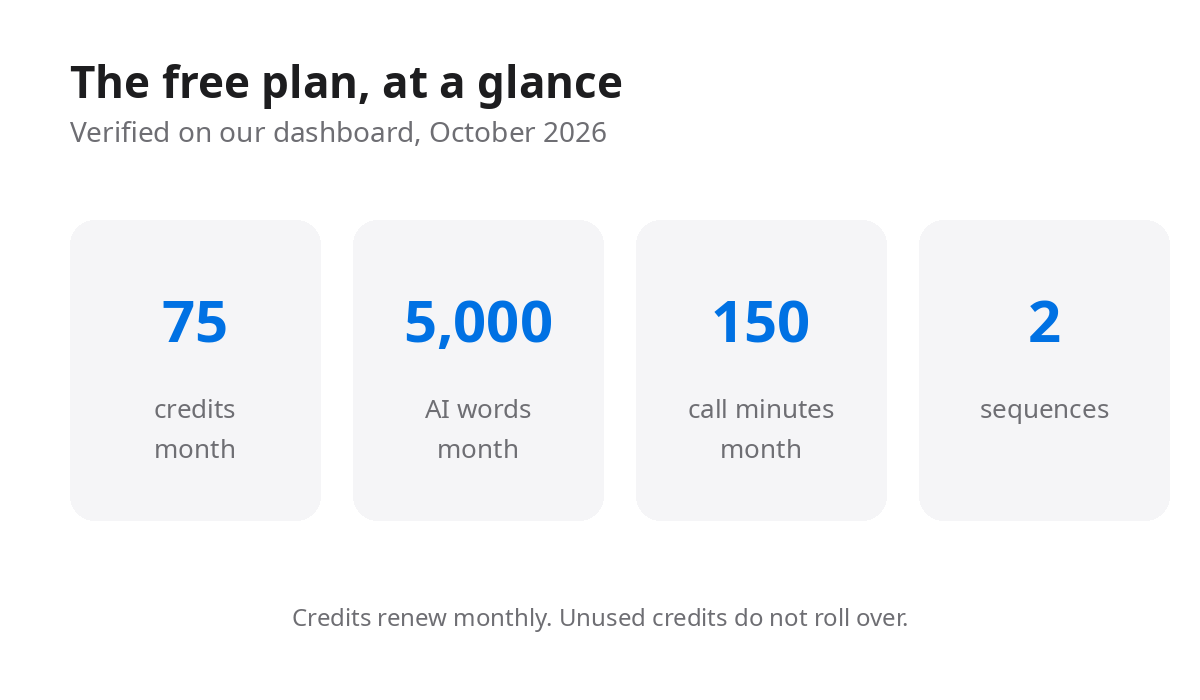
| Credits | 75 / month (900 / year), renews monthly |
| AI-generated words | 5,000 / month |
| Conversation (call recording) minutes | 150 / month |
| Sequences | 2 |
| Intent topics | 1 |
| Mailbox connections | Gmail only |
Our dashboard showed “75 credits,” 0 used, with renewal dated November 10. That settles the 50-vs-75-vs-100 debate for now: it’s 75 a month, granted monthly, and they don’t roll over.
Test 1: Signing up — Gmail gets rejected
The first wall appeared before we’d even entered the product. We typed in a Gmail address and Apollo rejected it outright: “Please sign up with a corporate domain or use the Google/Microsoft options.” Clear enough — except that clicking “Sign up with Google” with the very same Gmail address worked perfectly.
It’s confusing messaging for what’s presumably the most common signup path on earth. Whatever the reason, if you’re signing up with a personal address, use the Google or Microsoft button — and budget two minutes, not thirty seconds.
Test 2: Searching costs nothing — but watch what you search
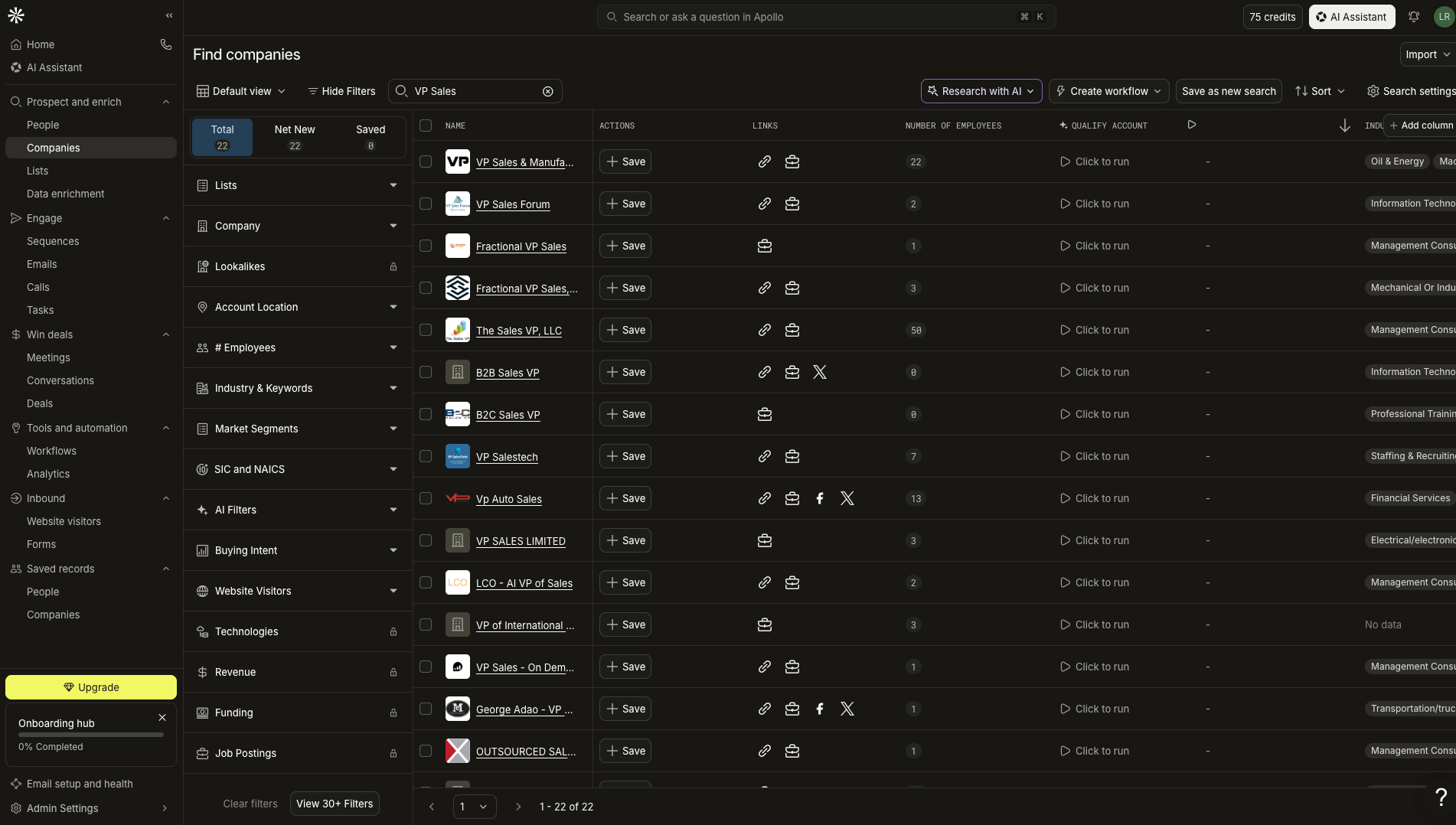
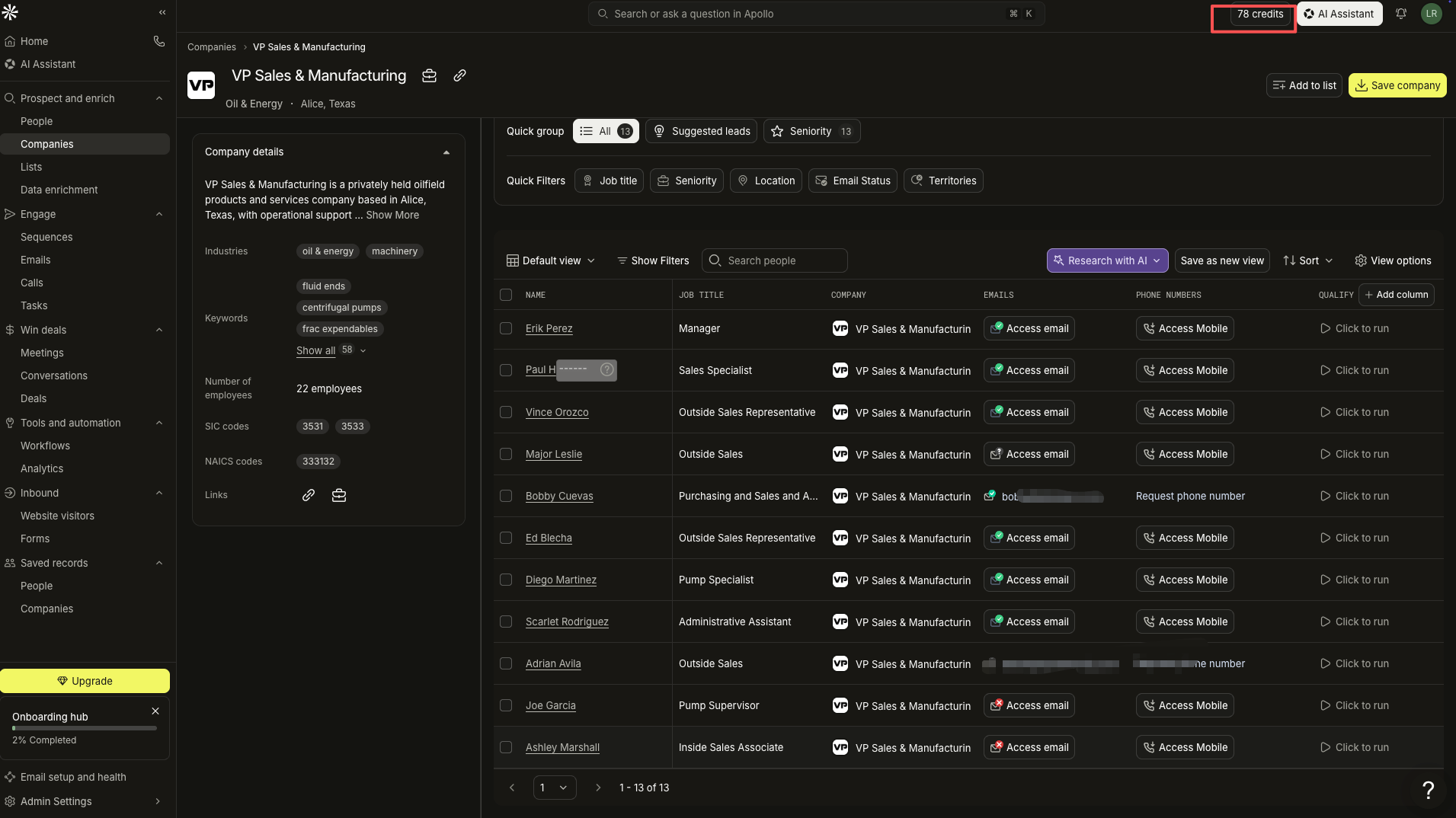
Our first real search was a deliberately lazy one: we typed “VP Sales” into Apollo’s search box. It returned 22 results — companies, not people, each literally named something like “VP Sales”. The keyword matched company names, not job titles.
That’s a useful lesson in how Apollo’s search behaves: keyword queries sweep across company profiles by default. If you want people with a particular title, use the People tab and its title filters instead of the generic search box.
The good news: our credit balance stayed at 75 throughout. Searching costs nothing — the meter only starts running when you reveal data.
Test 3: Revealing one email — the balance went up
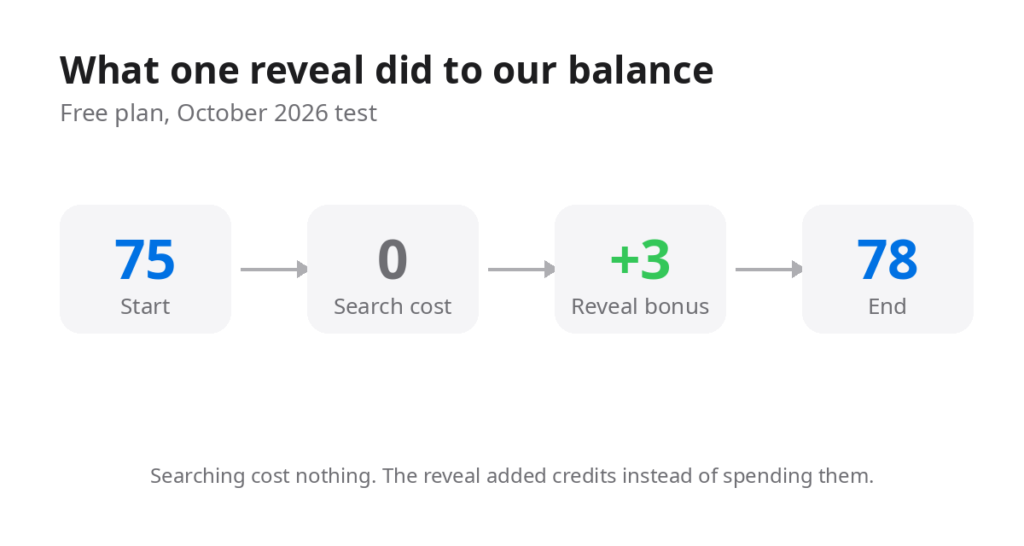
Next, we clicked “Access email” on one contact to reveal a single email address. We checked the balance before and after: it went from 75 to 78. Three credits added, none spent.
We’re confident about the numbers, less confident about the mechanism. The balance simply moved in the wrong direction for a “reveal costs credits” model.
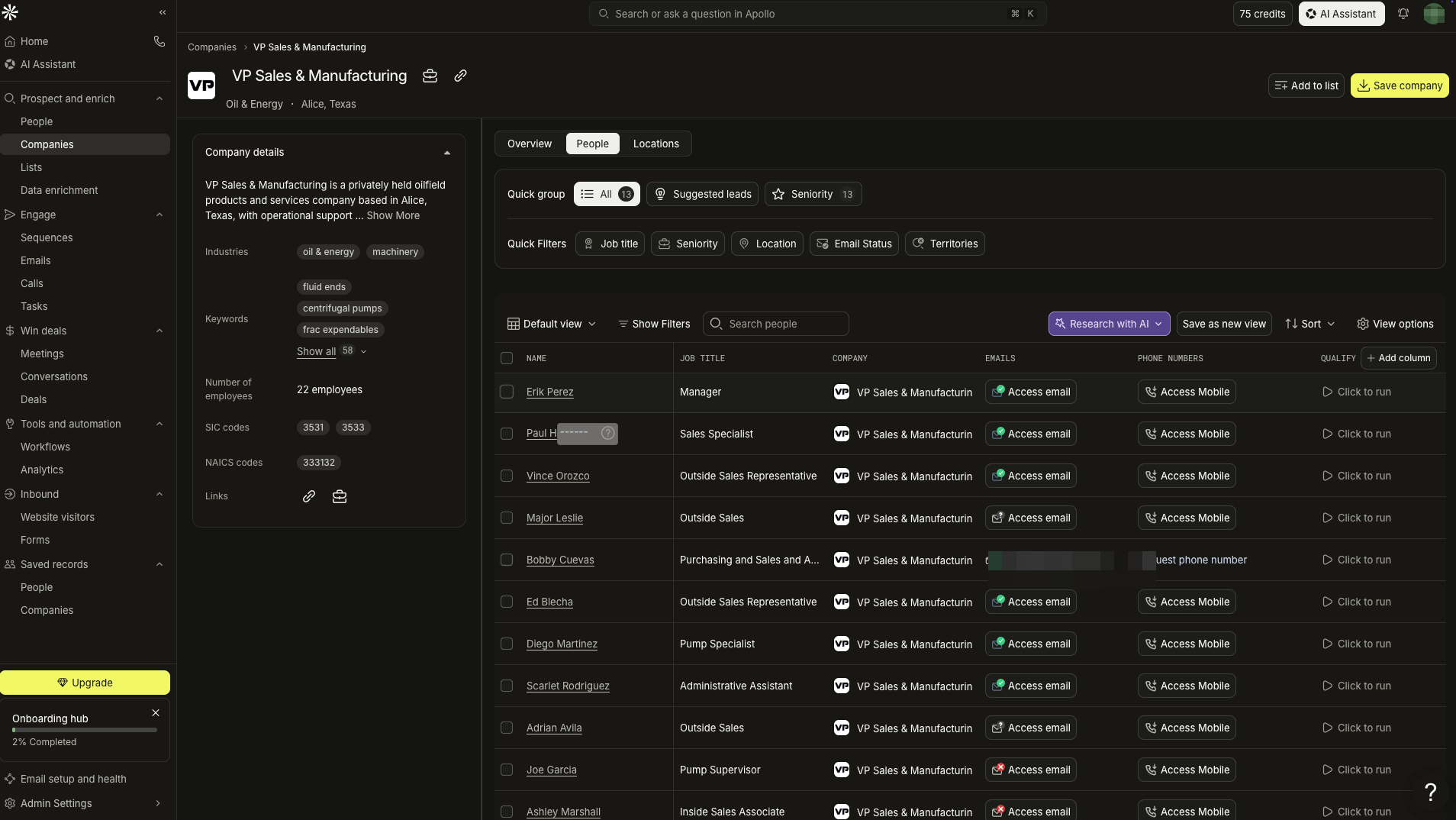
Our best reading is a small new-user bonus applied at some point during the session — but one data point isn’t a pricing table, so treat that as a guess. The practical takeaway is friendlier: poking around the free plan doesn’t visibly drain your wallet.
What’s locked behind the paywall
The free plan is clearly a trial surface, and Apollo doesn’t hide that. Advanced filters — Lookalikes, Technologies, Revenue, Funding, Job Postings — are locked, each with the familiar yellow Upgrade button beside it.
The structural limits are just as visible: 2 sequences, 1 intent topic, Gmail-only mailbox connections, and a 25-record selection limit. Enough to evaluate the workflows; not enough to run them at volume.
The math: what does 75 credits actually buy?
What you can do with 75 credits depends entirely on what you spend them on. Phone numbers are the expensive item — at the free plan’s rates, you’d get roughly nine a month. Email reveals are far cheaper, which is where most evaluators will spend their budget.
And remember: searching itself is free. You can explore, build lists, and check data quality before committing a single credit. It’s a genuine trial budget for testing the product — not pipeline volume for running it.
Verdict: solid for evaluation, not for operation
The free plan is what it claims to be: a real grant of 75 credits a month, free search, and a clearly signposted paywall. For evaluating Apollo’s data quality and workflows before paying, it’s genuinely useful.
The wobbles are real but small: the confusing Gmail signup messaging and the bot check that kept us out of parts of the search product. Neither is a dealbreaker for an evaluation — but both are worth knowing about before you start.
Tested October 2026 on Apollo.io’s free plan. Plans change — if your dashboard shows different numbers, tell us and we’ll re-test.
Sources:
- Apollo’s official pricing page — free plan: 900 credits/seat/year (~75/month), 2 sequences, Gmail-only mailbox (checked October 2026).
- Our own Apollo dashboard screenshots (October 2026) — 75 credits shown, 0 used, renewal dated November 10. See the screenshots above.
- Note: other roundups disagree on the free tier — 50 vs 100 credits a month. See uplead, saleshandy, fullenrich and smartreach. We report only the 75 credits shown on our own dashboard.
Want the numbers in one place? Get the free 2026 Cold Email Limits Cheat Sheet.
Want to know how we test? Read how we test B2B tools.
The links in this article are plain links — Sosolids earns nothing if you sign up through them.
Pingback: Best Cold Email Software for Small Business (2026): 7 Compared